27.8.10

Book of the Week: 23-29 August

Amy the Dancing Bear
by Carly Simon
illustrated by Margot Datz


Though it's written by Carly Simon -- yes, THAT Carly Simon (the famous singer-songwriter) -- don't read Amy the Dancing Bear for the prose, which can seem at times like she's trying too hard to sound quaint and charming. What I love about it are the soft illustrations and the blossoming page borders, which are perfect for an end-of-August evening. The words work in concert with the drawings to evoke a lovely, fragrant summer night, and it's impossible not to feel relaxed and comforted once you reach the end of the sweet little story about an impetuous young dancing bear whose mother just wants her to go to sleep. In essence, it's sort of the literary equivalent of an Enya song -- relaxing and beautiful, but not too substantive. It's not going to win any literary awards, and it's certainly not going to make you contemplate the deep philosophical questions of the universe, but I love it for the mood it creates and its pitch-perfect recreation of a perfect summer night.

26.8.10

Save Water America

Source
 
Have you used water today? Taken a shower? Washed your hands? Taken a drink? Brushed your teeth?

Because the vast majority of us have indoor plumbing, it's easy to take water for granted. But with simple adjustments to our behavior, we can help conserve this essential resource.

At SaveWaterAmerica, you can take a three-question quiz to see how much money you can conserve by switching to a more efficient toilet. Though the website (and quiz) are basically just a commercial for Kohler's products, once you take the quiz they will donate $1 to Habitat for Humanity to help fund water-saving projects.

Over at Water: Use it Wisely they have a list of 100 Ways to Conserve Water. Some of them are pretty obvious (like #5: Run your clothes washer and dishwasher only when they are full. Or #29: When running a bath, plug the tub before turning the water on, then adjust the temperature as the tub fills up.), but others are helpful and easy to implement (like #17: Collect the water you use for rinsing fruits and vegetables, then reuse it to water houseplants. And #83: Washing dark clothes in cold water saves both on water and energy while it helps your clothes to keep their colors.).

I know I'm guilty of taking showers that are WAY too long. By limiting the length of my showers by being more aware of the time I'm taking, I know I'll be conserving water and saving on the water bill. 

What are some ways that YOU limit your water consumption?

25.8.10

Influences and Inspirations

I wasn't able to get very good pictures of this outfit, which is unfortunate because I was very excited about it. Its creation was the result of a confluence of many influences, from this fabulous DIY skirt tutorial from What Would a Nerd Wear, these clever little faux-suspenders from Barefoot and Vintage, and all of the wonderful color mixing tips from the girls over at Academichic.


Shirt: Target
Skirt: self-made
Scarf: J. Crew
Belt: Target
Shoes: Nine West

Being silly in front of an incredible car


I also got bangs yesterday (after these pictures were taken), which I'm pretty sure I haven't had since about 1997. It's both terrifying and exhilarating.

24.8.10

Super


I'm a sucker for anything retro or geeky, and these incredible posters by artist RoganJosh (or "modHero") are both! Some of them are even too geeky for me (I must admit I've never heard of Havok and Polaris), but they are all gorgeous and witty. See the whole collection here.

23.8.10

Never Worn Challenge

I know I can't be alone in this: you buy something, whether by necessity or by choice, and it languishes unworn in your closet because you're afraid of it. You're unsure how to style it, or you're afraid it's just "not you," or you secretly worry that it's actually super heinous.

Well, I've challenged myself to actually wear the things I've never worn, to confront my fears, to wear boldly what I've never worn before!

First up for this challenge are my graduation shoes. We were required to find white shoes with ridiculous specifications (I don't even remember all of them, but it had to have at least a one-inch or more, all-white heel, which is kind of like trying to find a unicorn). In the end, after many hours of searching, this is what I finally found:


They're a sort of 60's-mod-meets-The-Jetsons T-strap. I didn't feel like they really fit into my personal style, and wouldn't have known how to wear them anyway.

This summer, I knew the time had come. I mustered up the courage, dragged them out of my closet, brushed off the dust and cobwebs (just kidding...kind of), and paired them with fresh, bright pieces:


Shirt: JC Penny's
Shorts: DIY cutoffs (more on these to come)
Shoes: Nine West
Scarf: J. Crew
Necklace: Self-made
The magical thing is, now that I've worn them once, the fear is gone! Not only did I get multiple compliments on them, I now know that they can work with what I've got in my wardrobe.


21.8.10

From Russia, With Life


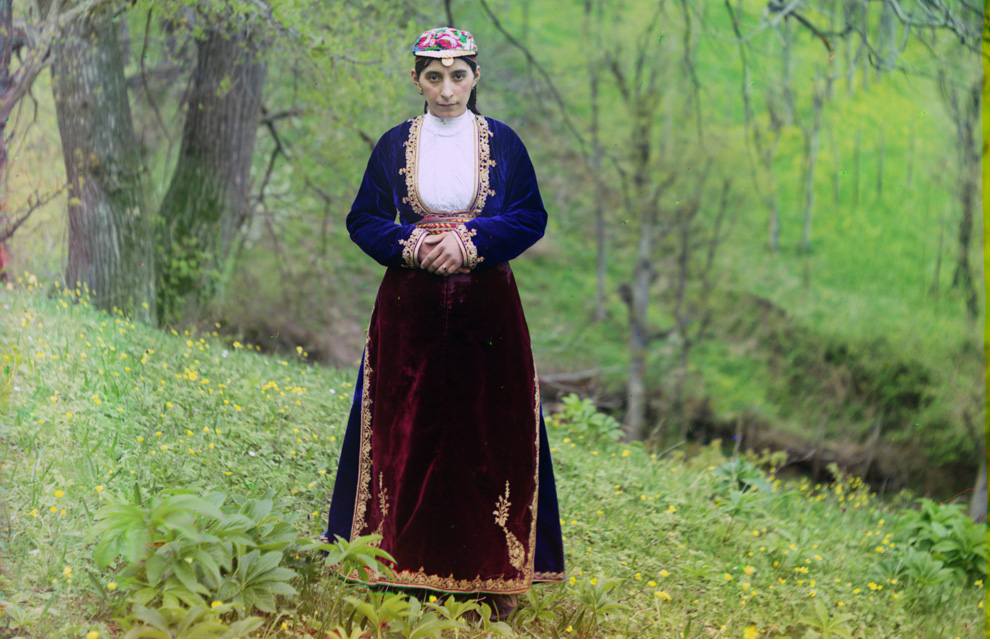
When would you guess this photograph was taken?


What about this one?


Or this one?

To my eye, the vivid colors and sharp focus suggest that it could have been yesterday, perhaps taken with a high-end Digital SLR.

If you're anything like me, then, you'd be shocked to discover that they were each taken a century ago, the first one in 1911 and the other two in 1910. These, and many more (found here), were taken by Russian photographer Sergei Mikhailovich Prokudin-Gorskii (say that five times fast. Or like, once, accurately.) who used a "specialized camera to capture three black and white images in fairly quick succession, using red, green and blue filters, allowing them to later be recombined and projected with filtered lanterns to show near true color images" 

For me, looking at these pictures is nothing short of mind-blowing. Logically, I can read that the pictures were taken between 1909 and 1912. I can see the outmoded clothing styles and the antiquated architecture. But when I force myself to truly believe that these were taken one hundred years ago, I can barely comprehend the thought. For years when I was much younger I think I believed, to a certain extent, that the world existed entirely in soft-edged black and white sometime before 1950. Because I had never seen it, I genuinely could not conceive of the people I saw in movies of that era -- Abbot and Costello, The Marx Brothers, even Katherine Hepburn, Jimmy Stewart or Cary Grant -- as existing in a color-filled world. I had never seen it, therefore I could not believe it. 

As I grew older, it dawned on me that people of every era, be they flappers from the 1920's or shepherds in Ancient Greece, saw themselves and each other as vividly as I saw myself and my contemporaries. Again, I knew this intellectually, but had a difficult time actually visualizing it. Until now. These pictures, with their crisp colors and details, let me see the Russia of one hundred years ago as its inhabitants would have experienced it. 


My physics professor last year told us of a study that was conducted some years ago. Aristotle, arguably the most famous (and most boldly incorrect) scientist to come out of Ancient Greece, believed that the speed of an object's fall is proportional to its weight. That is to say, if a bowling ball and a pebble were dropped from a great height at exactly the same time, the bowling ball would hit the ground much sooner than the pebble. This seems logical enough, and most people without any scientific training probably believe this to be true. However, Aristotle had never actually performed the experiment, and it wasn't until the late sixteenth century that Galileo disproved this faulty hypothesis. Those with a background in science are taught that Aristotle was wrong and that the objects would fall at essentially the same rate. Researchers at...Some College in Some City Somewhere showed two groups of students two different movie clips. In one clip, two objects of different weights are falling with equal speed. In the other, the heavier of the two is falling faster, thus defying physics. One experimental group was made up of science majors who would almost certainly know which video showed the "correct" physics. The other was made up of those without a background in science (English majors, anyone?). The researchers then monitored their brain activity and discovered something interesting: in the brains of the science majors, when they saw the physics-defying video, a certain chemical was released into the part of the brain that detects non-sequitors and things that don't or shouldn't make sense. In the brains of the other students, the same chemical was released into that same part of the brain, except this time it happened when they saw the one with the correct physics that only seemed incorrect. 


Whew! Okay, everyone can wake up now. What I meant by that long-winded and seemingly unrelated anecdote is that I feel exactly like those English majors in the study when I look at these photographs. My brain is calling shenanigans on these pictures, telling me they can't possibly be showing me images from so long ago with such clarity and realism, even though my brain is wrong -- they are images from a century ago, and this was what things would have looked like to observers at the time. 


All of this reminds me of a segment on page 34 of the novel Atonement. Briony, a precocious thirteen-year-old, is having some philosophical thoughts, pondering existence and perception. She wonders:
Was everyone else really as alive as she was? For example, did her sister really matter to herself, was she just as valuable to herself as Briony was?Was being Cecilia just as vivid an affair as being Briony? Did her sister also have a real self concealed behind a breaking wave, and did she spend time thinking about it...? Did everybody, including her father, Betty, Hardman? If the answer was yes, then the world, the social world, was unbearably complicated, with two billion voices, and everyone's thoughts striving in equal importance and everyone's claim on life as intense, and everyone thinking they were unique, when no one was. One could drown in irrelevance. But if the answer was no, then Briony was surrounded by machines, intelligent and pleasant enough on the outside, but lacking the bright and private inside feeling she had. This was sinister and lonely, as well as unlikely. For, though it offended her sense of order, she knew it was overwhelmingly probable that everyone else had thoughts like hers. She knew this, but only in a rather arid way; she didn't really feel it.
I'm sure most of us have felt this way in the past, marveled at the miracle of consciousness and the fact that everyone around us is equally as real and as alive as we are. But I think it's easy to forget that this was the case for all those who came before us, not to mention all those who will come after. And these pictures have thrown this truth into sharp focus for me -- in more ways than one.

ca. 1910

ca. 1909

ca. 1910

ca. 1910

20.8.10

Book of the Week: 16-22 August

Atonement
by Ian McEwan


Have you ever waited for something with incredible excitement and anticipation, building up a near-impossible, idealized image of what it will be like? And have you ever had the real thing exceed that expectation? 

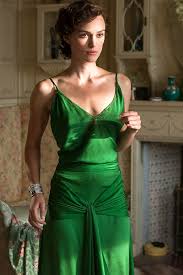
That's essentially what happened for me with Ian McEwan's novel, Atonement. I saw the film adaptation starring Kiera Knightly and James MacAvoy in 2008 and immediately wanted to read the book. I was curious how the stunning visuals and cinematography would translate to the page. On a whim, I read one of McEwan's short stories before I was able to get my hands on Atonement and was struck by his ability to fearlessly confront the darkness of the human spirit without veering into the melodramatic. This particular short story, entitled "Solid Geometry," was macabre and, ultimately, deeply disturbing, but was executed with such precision and beauty that I was left pleasantly stunned and wonderfully uncomfortable.

I finally found a copy of Atonement at my local library (three cheers for the public library system!) and could not have been more pleased with it. I'm fairly sure McEwan could describe, in intimate detail, the subtle grace and beauty of a piece of belly button lint, and I would eagerly devour every word. The landscapes he paints are as vivid as technicolor and are pulsing with life, but he also appeals to the other senses by showing you exactly how a hot summer day in the English countryside smells and feels and sounds.

In addition to the immersive scenes he creates, which I was almost expecting after the gorgeous and dreamlike visuals of the film, each of his characters is thoroughly human in ways sometimes shocking and unexpected and in other ways perfectly mundane. This blend of total familiarity and absolute strangeness is what makes his work so chilling and compelling. To see characters thinking something you yourself have thought, who then suddenly do something you would never dream of, is quite startling; it makes you wonder if you truly are above such actions, as you fervently hope to be.

I can't sing the praises of Atonement enough -- you really much must read it yourself. McEwan's writing style and intricately woven plot propel the reader forward and make for an engrossingly rapid read. And when you've finished, reward yourself by watching the film -- even if you didn't like the story, the beautiful cast, costumes, scenes, and cinematography will keep you enthralled.


Photos here, here, here, and here